Working with mocks stored in Diffsky-native format
This notebook shows how to load diffsky data, and compute photometry and high-res SEDs, using mock data stored in the flat hdf5 format natively produced by Diffsky.
Note: Note: There are separate OpenCosmo-formatted data products that enable efficient querying and filtering with the OpenCosmo toolkit. We recommend most users work with OpenCosmo-formatted diffsky mocks, for which there is a separate tutorial.
Diffsky-native data format
The mock data natively produced by diffsky is stored as a collection of flat hdf5 files. Each hdf5 file has a name such as:
lc_cores-{stepnum}.{lc_patch}.diffsky_gals.hdf5,
where stepnum specifies the N-body simulation snapshot, and lc_patch specifies the patch of sky. Galaxies with the same stepnum occupy the same narrow range of redshift, and galaxies with the same lc_patch fall within the same contiguous patch of {ra, dec}.
By contrast, the OpenCosmo library reorganizes the diffsky-native format by collating all hdf5 files at the same redshift, "lc_cores-453.0.diffsky_gals.hdf5", "lc_cores-453.1.diffsky_gals.hdf5", etc., into a single hdf5 file, "lc_cores-453.diffsky_gals.hdf5".
The next cell shows how to load all the mock data stored in a single diffsky-native file, "lc_cores-453.0.diffsky_gals.hdf5".
[1]:
import numpy as np
from matplotlib import pyplot as plt

import os
drn_mock = "mock_download_dir"
bn_mock = "lc_cores-453.0.diffsky_gals.hdf5"
fn_mock = os.path.join(drn_mock, bn_mock)

from diffsky.data_loaders.hacc_utils import load_lc_mock as llcm
diffsky_lc_patch, metadata = llcm.load_diffsky_lc_patch(fn_mock)
Inspect the mock data
The diffsky_lc_patch dictionary stores every column of the mock, along with supplementary metadata needed to compute photometry. Note that if you only need a subset of the columns, you can pass the keys keyward argument to the load_diffsky_lc_patch function.
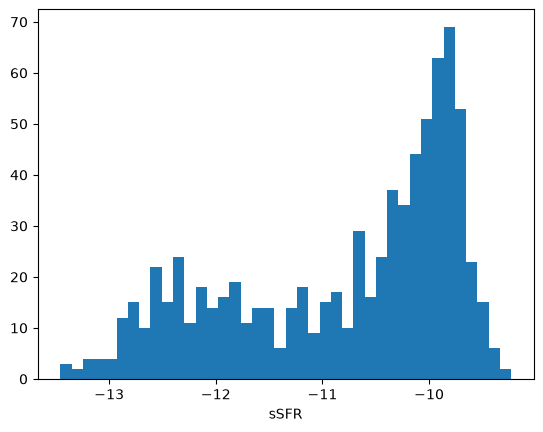
In this next cell we’ll take a look at a histogram of specific star formation rate, sSFR = log10(Mstar/SFR).
[2]:
fig, ax = plt.subplots(1, 1)
__=ax.hist(diffsky_lc_patch['logssfr_obs'], bins=40)
xlabel = ax.set_xlabel('sSFR')
Examining mock photometry
The data stored in diffsky_lc_patch and metadata have all that is needed in order to recompute the photometry in the mock with the compute_phot_from_mock function. In the next few cells we’ll see how to recompute the photometry for a subset of the transmission curves used to make the mock.
The tcurves entry of metadata is a namedtuple that stores all of the transmission curves that were used to generate the mock photometry. You can see what bandpasses are present in the mock by inspecting the fields:
[3]:
print(metadata['tcurves']._fields)
('lsst_u', 'lsst_g', 'lsst_r', 'lsst_i', 'lsst_z', 'lsst_y', 'roman_F062', 'roman_F087', 'roman_F106', 'roman_F129', 'roman_F158', 'roman_F184', 'roman_F146', 'roman_F213', 'roman_Prism', 'roman_Grism_1stOrder', 'roman_Grism_0thOrder')
For each bandpass, there is a corresponding column of mock data storing the photometry through that filter:
[4]:
for bandpass_name in metadata['tcurves']._fields:
    assert bandpass_name in diffsky_lc_patch.keys()
Recomputing mock photometry
In the next few cells, we’ll recompute photometry through the "lsst_u" and "lsst_i" bands, and then compare the recomputed result to the corresponding columns of the mock.
Calculating photometry/SEDs in batches
Depending on your available computing resources, you may need to compute photometry for only a chunk of the data at a time to avoid overflowing memory.
Important note: Use the get_lc_mock_chunk function to grab a chunk of mock data. If you attempt to compute photometry or SEDs for an arbitrarily subdivided diffsky_lc_patch, you will get incorrect results, because the data chunk needs to have a complete set of satellite galaxies for each central.
[5]:
batch_size = 20
nchunks = llcm.estimate_nchunks(fn_mock, batch_size)

chunknum = 0
diffsky_lc_patch_chunk = llcm.get_lc_mock_chunk(
    diffsky_lc_patch, metadata,
    nchunks=nchunks, chunknum=chunknum)
By default, the compute_phot_from_mock function assumes you want to recompute photometry through all available bands. You can use the tcurves argument to select a subset of transmission curves for which to compute photometry. In this next cell, we’ll pick just two bands: u and i, and show that our recomputed photometry agrees with the corresponding columns in the mock.
[6]:
all_tcurves = metadata['tcurves']

from collections import namedtuple
Tcurves = namedtuple("Tcurves", ("lsst_u", "lsst_i"))
tcurves = Tcurves(all_tcurves.lsst_u, all_tcurves.lsst_i)

from diffsky.data_loaders.hacc_utils import sed_from_mock
phot_info = sed_from_mock.compute_phot_from_mock(
    diffsky_lc_patch_chunk, metadata, tcurves=tcurves
)

assert np.allclose(
    diffsky_lc_patch_chunk['lsst_u'],
    phot_info['obs_mags'][:, 0], rtol=1e-4)
assert np.allclose(
    diffsky_lc_patch_chunk['lsst_i'],
    phot_info['obs_mags'][:, 1], rtol=1e-4)
Recompute photometry of disk/bulge/knot decomposition
The photometry of each morphological component can be calculated using the compute_dbk_phot_from_diffsky_mock function.
[7]:
dbk_phot_info, dbk_weights = sed_from_mock.compute_dbk_phot_from_mock(
    diffsky_lc_patch_chunk, metadata, tcurves=tcurves)

assert np.allclose(
    diffsky_lc_patch_chunk['lsst_u_bulge'],
    dbk_phot_info['obs_mags_bulge'][:, 0], rtol=1e-4)
assert np.allclose(
    diffsky_lc_patch_chunk['lsst_i_bulge'],
    dbk_phot_info['obs_mags_bulge'][:, 1], rtol=1e-4)
Compute SED of diffsky galaxies
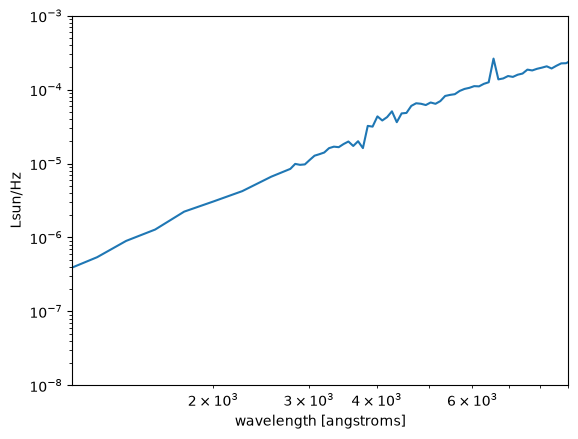
There is also a convenience function for computing the high-resolution SED of each diffsky galaxy.
[8]:
sed_info = sed_from_mock.compute_sed_from_mock(
    diffsky_lc_patch_chunk, metadata)
[9]:
fig, ax = plt.subplots(1, 1)
__=ax.loglog()
xlim = ax.set_xlim(1_100, 9_000)
ylim = ax.set_ylim(1e-8, 1e-3)

igal = 5
__=ax.plot(metadata['ssp_data'].ssp_wave,
           sed_info['rest_sed'][igal, :])
xlabel = ax.set_xlabel('wavelength [angstroms]')
ylabel = ax.set_ylabel('Lsun/Hz')
Compute SED of disk/bulge/knot components
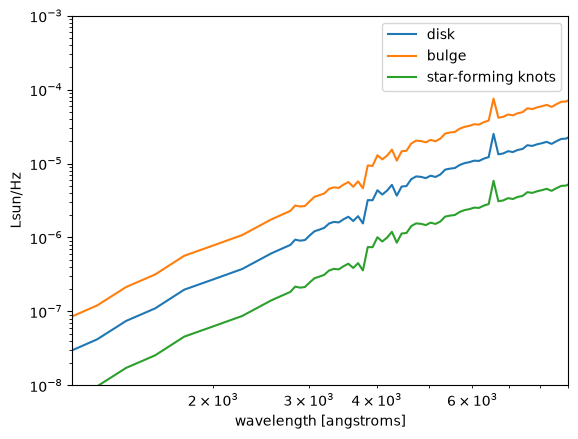
There is an additional convenience function for computing the high-resolution SED of each morphological component.
[10]:
dbk_sed_info = sed_from_mock.compute_dbk_sed_from_mock(
    diffsky_lc_patch_chunk, metadata)
[11]:
fig, ax = plt.subplots(1, 1)
__=ax.loglog()
xlim = ax.set_xlim(1_100, 9_000)
ylim = ax.set_ylim(1e-8, 1e-3)

igal = 12
__=ax.plot(
    metadata['ssp_data'].ssp_wave,
    dbk_sed_info['rest_sed_disk'][igal, :], label='disk')
__=ax.plot(
    metadata['ssp_data'].ssp_wave,
    dbk_sed_info['rest_sed_bulge'][igal, :], label='bulge')
__=ax.plot(
    metadata['ssp_data'].ssp_wave,
    dbk_sed_info['rest_sed_knots'][igal, :], label='star-forming knots')
xlabel = ax.set_xlabel('wavelength [angstroms]')
ylabel = ax.set_ylabel('Lsun/Hz')
leg = ax.legend()
Computing photometry in other bands
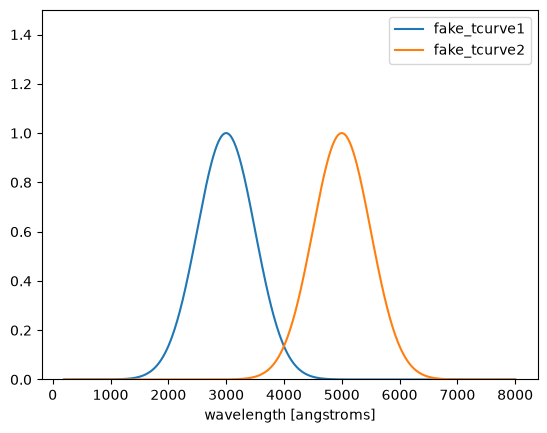
You can compute photometry in other bandpasses by using the tcurves argument to store any sequence of transmission curves. Each individual transmission curve must be a namedtuple with two fields: wave and transmission; your sequence of transmission curves also needs to be formatted as a namedtuple, using whatever names you want to name each bandpass.
The next few cells show how to compute photometry through two arbitrary bandpasses.
[12]:
from jax.scipy.stats import norm as jnorm
from collections import namedtuple
TransmissionCurve = namedtuple(
    "TransmissionCurve", ("wave", "transmission"))

wave = np.linspace(200, 8_000, 500)

fake_tcurve1 = jnorm.pdf(wave, loc=3_000.0, scale=500.0)
fake_tcurve1 = TransmissionCurve(
    wave, fake_tcurve1/fake_tcurve1.max())

fake_tcurve2 = jnorm.pdf(wave, loc=5_000.0, scale=500.0)
fake_tcurve2 = TransmissionCurve(
    wave, fake_tcurve2/fake_tcurve2.max())

fig, ax = plt.subplots(1, 1)
xlabel = ax.set_xlabel('wavelength [angstroms]')
ylim = ax.set_ylim(0, 1.5)
__=ax.plot(fake_tcurve1.wave,
           fake_tcurve1.transmission, label='fake_tcurve1')
__=ax.plot(fake_tcurve2.wave,
           fake_tcurve2.transmission, label='fake_tcurve2')
leg = ax.legend()
[13]:
Tcurves = namedtuple("Tcurves", ("fake_tcurve1", "fake_tcurve2"))
fake_tcurves = Tcurves(fake_tcurve1, fake_tcurve2)

dbk_phot_info, dbk_weights = sed_from_mock.compute_dbk_phot_from_mock(
    diffsky_lc_patch_chunk, metadata, tcurves=fake_tcurves)
[14]:
print(dbk_phot_info['obs_mags'].shape)
(15, 2)